Lessons from the Career of Joe Newhouse
Nov 2026
I had the luck of becoming Professor Joe Newhouse's student in 2003, when I was born. From then on, Joe influenced every part of how I saw the world. Take a phrase like the "U.S. Senate." To a child, those words were a black box. But when Joe would speak over breakfast or a long neighborhood walk, they sprang to life. A bill had to be passed, and this senator or that would object, and the threat of the Supreme Court striking it down would moderate the debate. These conversations seemed like the most normal thing, until I realized with hindsight that they are hardly normal. Becoming Joe Newhouse's student, as his grandchild, was a great stroke of luck.
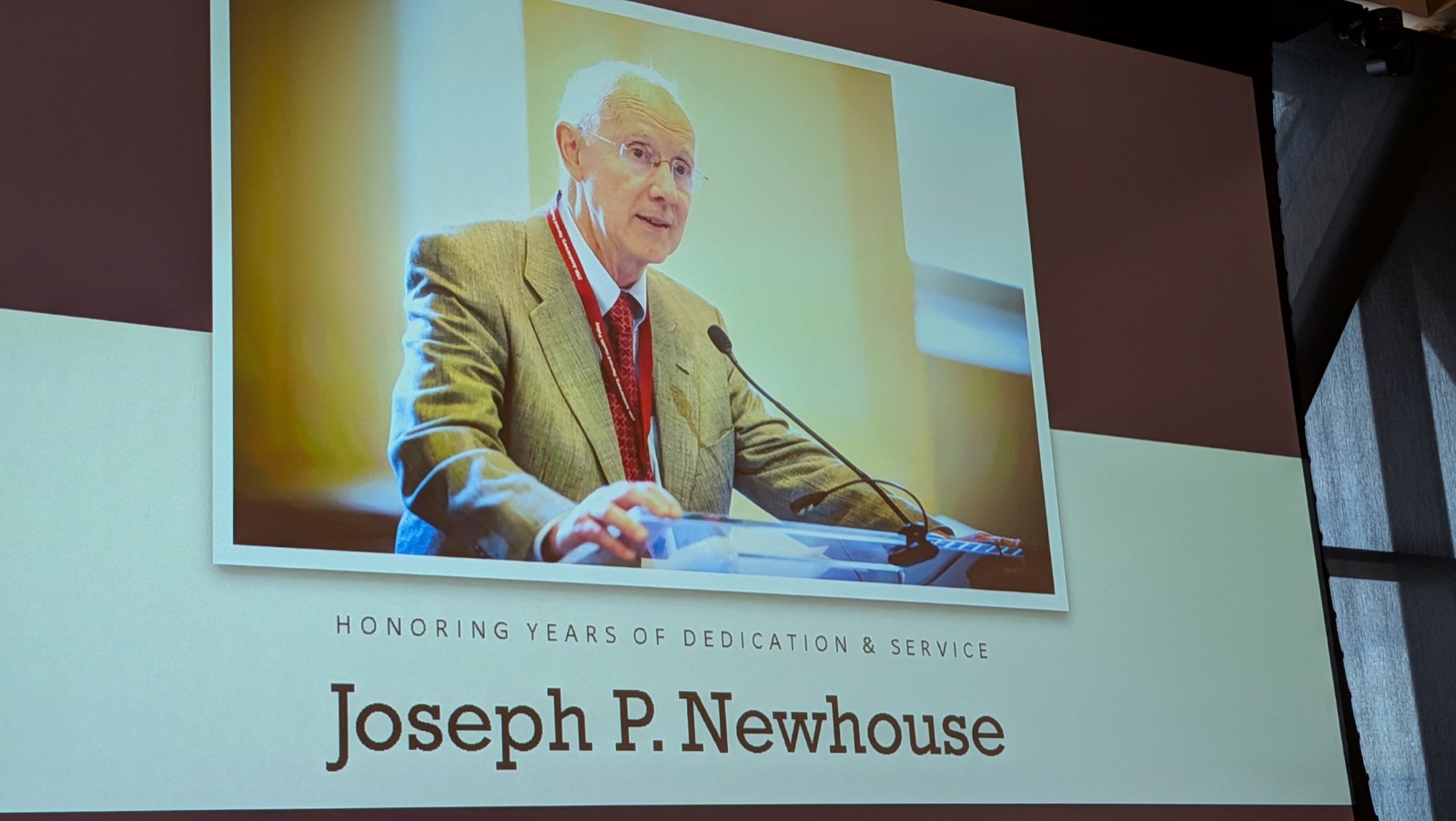
This November, Harvard celebrated the career of my grandfather. I heard stories ranging back as far as his childhood in the 1940s. I've collected some of these stories in the hopes their lessons may serve you.
Do things that will become more important over time.
Lest you think healthcare economics is niche, I will remind you that fifty years ago healthcare was 7% of the U.S. GDP. Now it is 18%. This topic is both close to home and critical for the nation, and Joe saw that decades ago.
Always curious, Joe asked why the fraction of healthcare spending was increasing. "It's the technology, stupid" is how most people memorably sum up the dynamic he found. New and expensive technologies drive up the cost of care, more than an aging population or other once-popular hypotheses.
Joe was early to see that the change over time of healthcare spending is what matters, and to characterize it. His foresight led him to study a topic that grew in importance over his lifetime. The same foresight empowered the atomic scientists of the 1930s (chain reaction) and the AI researchers of the 2020s (scaling laws).
To have a large impact, work on a topic that is growing and will likely continue to grow in importance.
Be generous, humble, and integral.
The problem of power without responsibility is that it can fester into corruption. To have not only a large, but a positive impact, brilliance must be augmented by character.
Once, Joe admitted a student who called in to say, "I think I'm going to delay starting for a year. I'm burnt out and want to work on a farm." In his classic way, despite how busy he must have been, Joe counseled this student about all the ways this wasn't yet a great plan. If one asks for input, Joe will give an honest appraisal of one's work, but always followed up by ideas for making it better and check-ins to support getting it done.
My father, as a child, often became frustrated that when debates arose Joe was always right. But however right he was, Joe was always patient. Actuaries in the U.S. government don't always get along with academic economists. Joe was one of the few to be friends with them: of the two economics papers cited in the 2026 Medicare Trustees’ Report, drafted by the CMS Office of the Actuary, both are authored by Joe. Time and time again Joe Newhouse showed up in these little ways, with generosity and humility, becoming beloved.
And with love from all, he stewarded his reputation with integrity. He explained what the data showed, not what people might wish it would show. His rigor was with him always. For those who want to become loved and be a force for good, be kind to others no matter their station, and follow not expediency, but the truth.
Measure the right thing.
"Would you tell me, please, which way I ought to go from here?"
"That depends a good deal on where you want to get to," said the Cat.
"I don't much care where—" said Alice.
"Then it doesn't matter which way you walk," said the Cat.
— Alice's Adventures in Wonderland
Though one's career and character may be in the right place, that is not yet any guarantee of success.
In the 1970s, Joe Newhouse led a seminal experiment showing that, contrary to some influential views of the time, people bought more healthcare if it was cheaper (price elasticity around -0.2). One way this result enters everyday life is co-pays at the doctor's office. Co-pays may be annoying, but they discourage people who clog up doctor offices with low-importance claims, freeing up doctors for higher-value care. Specifically, Joe showed that a small co-pay saves money on average but preserves outcomes (except for the poorest and sickest 5-10% of the population, which includes much of the Medicaid population; and the elderly were not part of the study).
A randomized control trial let Joe measure this result. It was hard and took a decade, and he would have been unable to do it in a university where tenure-seekers face mandatory incentives to publish quickly. Few universities even had the infrastructure to carry it out. But Joe creatively broke that constraint by doing his research at RAND.
In this way, Joe directly measured causality on health outcomes. But Joe also developed the first reasonably comprehensive measures of health outcomes and quality of care. Previously, it was common to measure mortality, but flawed because a lot of medical care is unrelated to mortality, such as hip and knee replacements and hearing aids. Even medical care that saves lives is often not the primary determinant of mortality.
Measure the wrong thing, and one risks summoning up a number-to-maximize that isn't the right thing to care about. Woe be upon engineers measured by lines of code or students measured by the word count of essays. Because he had measured the right thing, Joe's results became unassailable.
Measuring the right thing is still no guarantee of success, but it is a first step toward wisdom.
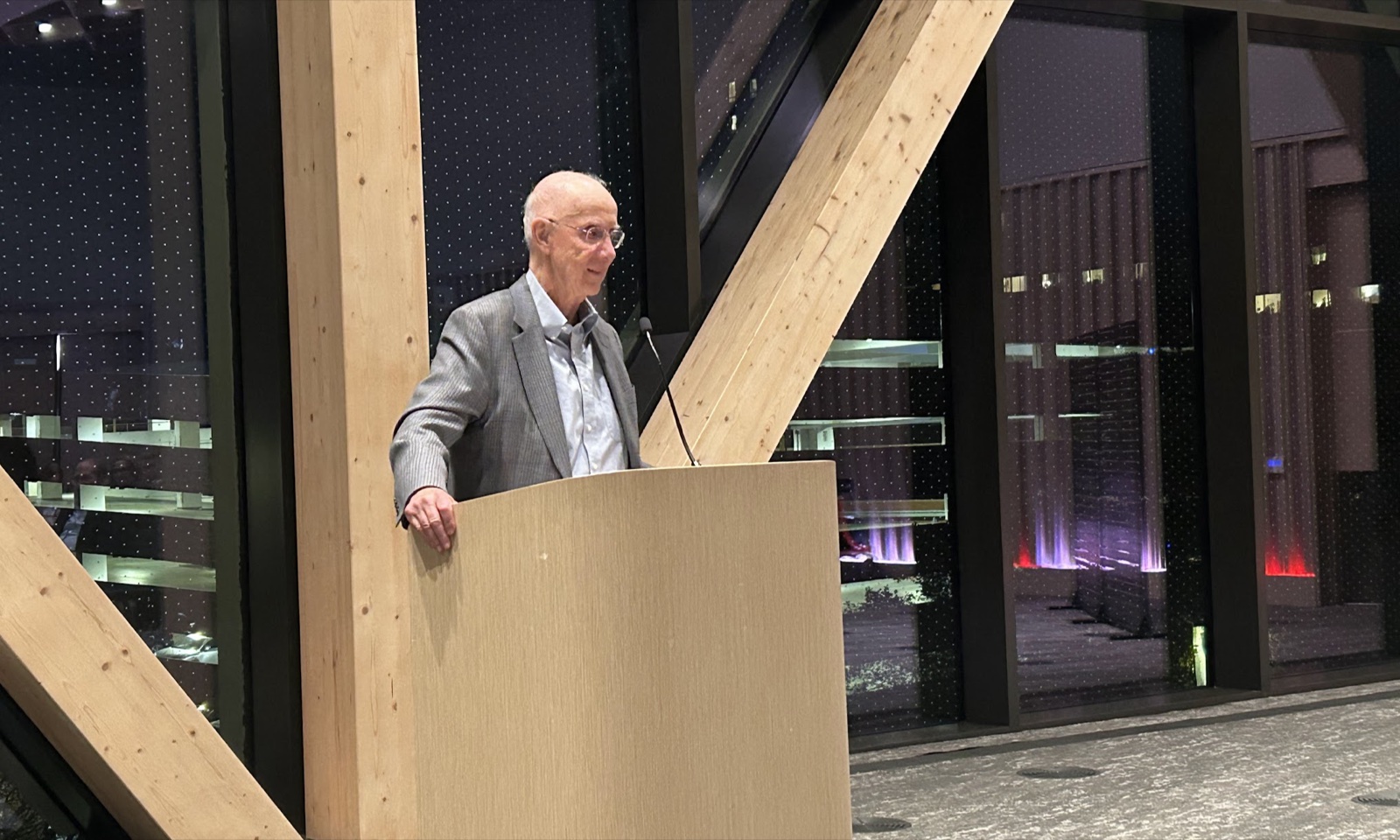
After the panels had spoken out their final comments, Joe gave his gratitude.
Many mentors had shaped him, he said, especially his undergraduate and graduate school adviser John Dunlop, who had also been President Ford's Secretary of Labor. "I've wanted to pay it forward," he concluded. "It's been gratifying to see all of you here on this panel, and I think I've done that thanks to many of you."
In his toast afterwards, President Alan Garber said, "Joe, I just want to say you are a role model. You model the right kind of forbearance in talking about your research and helping people understand what it means. When we served together on a study committee for the National Academy of Medicine, Joe insisted on explaining what the data showed, not what people wanted the data to show. The future of Harvard depends on exactly that. Look where the data lead you, without fear of how people will react. That is why Joe is an indispensable researcher. Thank you for showing us all the way. And there is one more person: Meg, thank you for making it all possible."
To Joe: thank you for admitting me into your program in 2003. Being your grandson has shaped me more than I knew when I was young, and I will take that worldview onwards into all of my life.
To the reader: be like Joe. Work in growing areas, have force of character, and measure wisely so as to get where you want to go. You may break constraints, but show kindness to all.
One last tip: give great hugs. There's not enough time on Earth to skip this important step, which Joe excels at.